

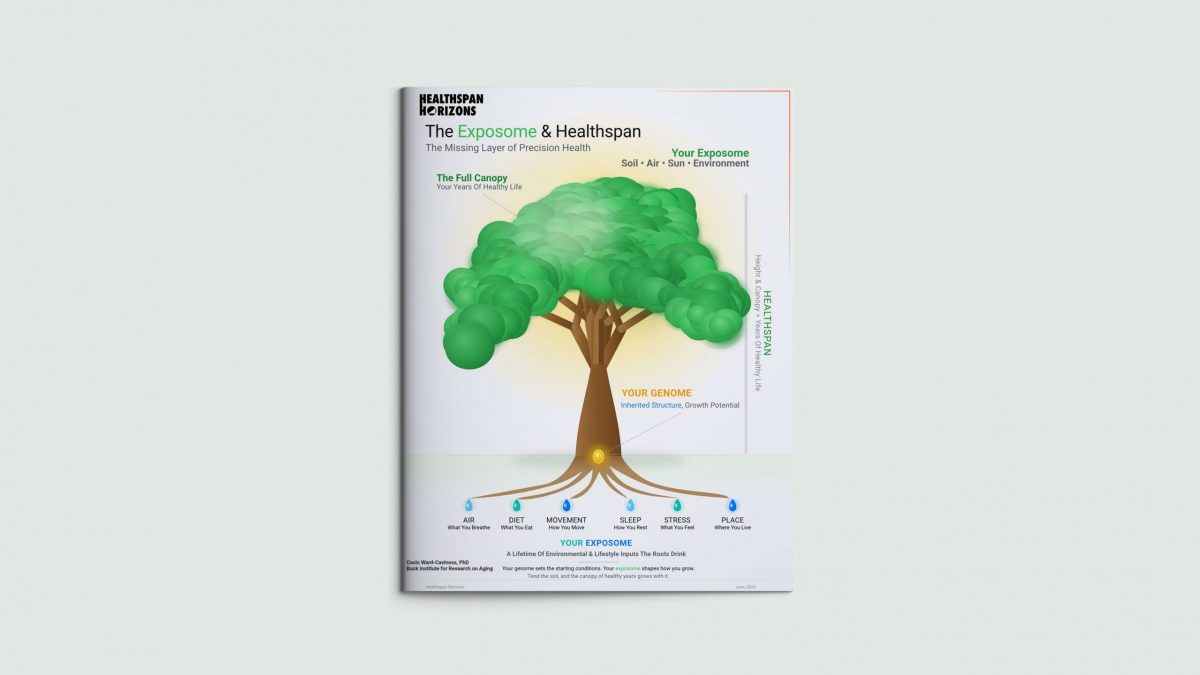
The exposome is the totality of environmental exposures we experience throughout life—from the air we breathe and the water we drink to the foods we eat, the places we live, the stress we carry, and the conditions in which we work and rest.
In this Perspective, environmental health scientist Dr. Cavin Ward-Caviness explores why the exposome may be the missing layer of precision health, how it influences the trajectory of aging long before disease appears, and why advances in AI, sensors, and longitudinal health measurement are creating new opportunities to understand and improve healthspan.
Key Insights
1. We Do Not Age in Isolation
Genes matter. But they do not act alone.
The environments we experience every day continuously shape how those genetic predispositions are expressed. The exposome influences how fast we age, how resilient we remain, and how long we stay healthy.
2. Environmental Exposures Converge on Common Biological Pathways
Many seemingly unrelated exposures—from air pollution and extreme heat to PFAS, noise, and chronic stress—ultimately affect a relatively small set of biological systems.
These pathways include:
- Inflammation
- Cardiometabolic health
- Molecular aging
- Resilience and homeostasis
Understanding these shared mechanisms helps explain why diverse exposures can produce similar health outcomes.
3. The Exposome Is a Computational Challenge
The exposome is dynamic, multidimensional, and constantly changing.
No individual can realistically track or interpret thousands of interacting exposures over a lifetime.
This is why AI becomes essential—not as a replacement for science, but as the infrastructure required to integrate environmental, biological, and behavioral information into meaningful health insights.
4. Resilience May Be the Most Important Healthspan Asset
Environmental exposures cannot be completely eliminated.
The goal is not perfect avoidance.
The goal is building resilience.
Individuals with greater physiological resilience often demonstrate greater capacity to withstand environmental stressors and maintain function over time.
5. Personalized Environmental Health Is Becoming Possible
Advances in molecular profiling, wearable technologies, environmental sensing, and artificial intelligence are making it increasingly feasible to measure, contextualize, and act upon environmental exposures.
A future of personalized environmental health may allow individuals to understand their unique risks, monitor their trajectories, and make informed decisions that improve long-term healthspan.
Why This Matters
Most healthcare systems focus on diagnosing disease after it appears.
The exposome offers a different perspective.
Environmental exposures often influence resilience, recovery, cognition, energy regulation, and biological aging years before disease becomes clinically visible.
Understanding these influences creates an opportunity to move from reactive care toward proactive healthspan optimization.
Read the Full Perspective
Download the complete publication to explore:
- The Exposome and Precision Health
- Environmental Drivers of Healthspan
- Molecular Aging and Resilience
- AI and Environmental Health Intelligence
- The Healthspan Data Stack
- Toward Personalized Environmental Health
