

Healthspan has become one of the defining goals of modern medicine.
Yet one fundamental question remains surprisingly unresolved:
How do we measure healthspan while life is still being lived?
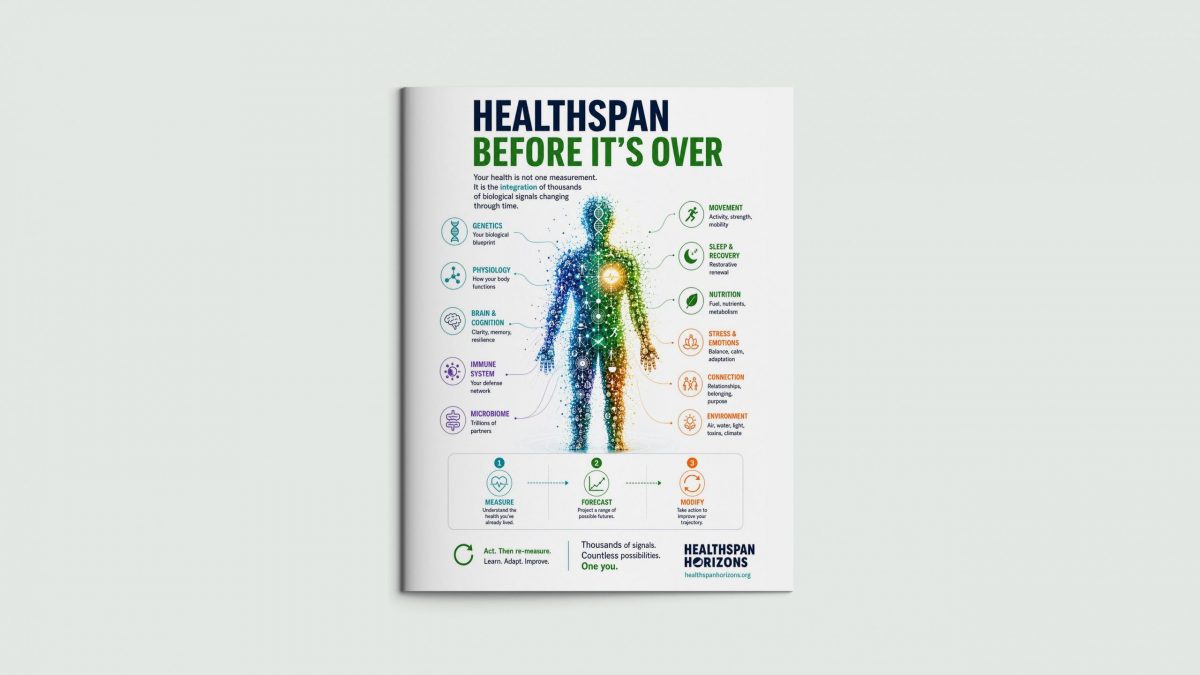
In this Healthspan Horizons Perspective, Nathan Price introduces the framework behind Lived Healthspan—a proposed scientific construct that connects retrospective measurement, future forecasting, and evidence-based action into one continuous learning system.
Rather than viewing healthspan as something counted only after life has unfolded, this perspective proposes a new scientific framework for making healthspan measurable, predictable, and modifiable while it still matters.
Final healthspan is retrospective. A person’s full, realized healthspan can be known with confidence only after the trajectory has unfolded, but health state, function, resilience, and change over time can be measured while life is still in progress.
Lived Healthspan is the measurable foundation Healthspan Horizons proposes. It is the running total of health-weighted years already lived—a research construct that still requires prospective validation.
A healthspan prediction should be a range, not a verdict. Current state, longitudinal trajectory, resilience, genetics, behavior, treatment, environment, and uncertainty all shape the forecast.
A predictive marker is not automatically a modifiable lever. Evidence that something predicts decline does not establish that changing it will improve health.
The framework is iterative. Measure, predict, modify, and measure again—while recognizing that modifiable conditions are not always personally controllable.
This Perspective introduces the core scientific concepts that underpin the Healthspan Horizons framework—from Lived Healthspan and resilience to trajectories, prediction, and modifiability. Together, they describe a new way of understanding health: one that continuously learns from the past, informs decisions in the present, and helps shape healthier futures
The proposed measure of the health-weighted years already lived.
Understanding not only where health is today, but how well we recover from life’s inevitable challenges.
Two people may have identical health today while heading toward very different futures.
Responsible forecasting estimates uncertainty—not certainty.
Not every predictor is a lever.
A variable that predicts decline does not necessarily cause decline.
An iterative scientific learning system for improving health over time.
Healthspan is the portion of life lived with good health, meaningful function, independence, and the capacity to do what matters. Researchers operationalize it in different ways—often through chronic disease, disability, frailty, functional limitation, or combinations of these—so there is not yet one universally accepted measure.
A person’s final, realized healthspan can be known with confidence only after the trajectory has unfolded. But current health state, physical and cognitive function, resilience, symptoms, well-being, and change over time can be measured now. The scientific challenge is integrating those signals into a valid whole-person measure that performs reliably across people and populations.
Healthspan can be forecast conditionally, but not as a precise number or a fixed destiny. A responsible healthspan prediction is a range of possible futures based on current state, longitudinal trajectory, resilience, genetics, behavior, treatment, environment, and uncertainty. The forecast should be updated as new measurements and individual responses accumulate.
Healthspan can often be preserved or improved, at least in part, through evidence-based lifestyle changes, appropriate medical care, and changes in environmental or social conditions. But a factor that predicts decline is not automatically a causal lever; modification requires evidence that changing it improves meaningful outcomes. Modifiable also does not mean entirely personally controllable.
Lived Healthspan is Healthspan Horizons’ proposed research concept for the running total of health-weighted years a person has already lived—the area under a multidimensional health-state curve up to today. It is intended to connect longitudinal measurement of past and present health to future forecasts and an iterative measure–predict–modify loop. It is not yet a validated clinical score.
These answers closely track the article’s central scientific distinctions: final versus present-tense healthspan, forecast versus fate, and prediction versus causation.
Dr. Nathan D. Price is a Professor and Co-Director of the Center for Human Healthspan at the Buck Institute for Research on Aging, and Chief Scientific Officer of Thorne HealthTech. He is a pioneer of systems biology and one of the leading architects of the scientific wellness movement—focused on measuring, predicting, and improving human health before disease onset.
Over more than two decades, his work has helped establish the computational and multi-omic foundations for modeling human health trajectories. He has authored more than 200 peer-reviewed publications, delivered over 250 invited talks, and was named an Emerging Leader in Health and Medicine by the National Academy of Medicine. He also serves on the Board on Life Sciences of the National Academies of Sciences, Engineering, and Medicine.
Dr. Price has consistently translated scientific innovation into real-world impact. He co-founded Arivale, one of the first platforms to deliver longitudinal, data-driven health insights to individuals, and later served as CEO of Onegevity. At Thorne, his work now reaches millions of consumers and tens of thousands of healthcare practitioners.
He is the co-author of The Age of Scientific Wellness (Harvard University Press, 2023), which introduced the scientific and conceptual foundations of personalized, data-driven health to a broad audience. His work continues to shape the emerging field of healthspan science—advancing a more predictive, preventive, and individualized model of care.
We share our work through a community model to ensure it reaches an engaged audience who values scientific rigor, thoughtful interpretation, and long-term progress in human health. We do not sell or misuse your information. Our approach is privacy-first and designed to build trust over time.
Already signed up? Please refer to your welcome email for your direct access link. If you can’t find it, feel free to fill out the form once more for immediate access.